

Twenty Shades of Blue is daCunha’s second incarnation of a project that I, along with Dwight Smith, saw in March at Morris Gallery of Contemporary Art in Marshall, MO. It’s a multi-disciplinary project with video, audience participation, aspects of sculptural installation, storytelling and collage. There are three expansive rooms of work at Bunker examining the artist’s story and in turn our own stories. The show’s topic is about what its like to observe and be observed.
I consulted Merriam-Webster’s Collegiate Dictionary (1993) before working on this. I didn’t know for sure what I knew. I knew the words “collage” and “diaspora” were part and parcel of daCunha’s form and content. What I didn’t know was that the dictionary entry before collage is “collaborate”. The word before diaspora is “diary”. The dictionary was telling me how this article was to proceed. It seemed nearly a mystical experience…too good to be coincidental1.
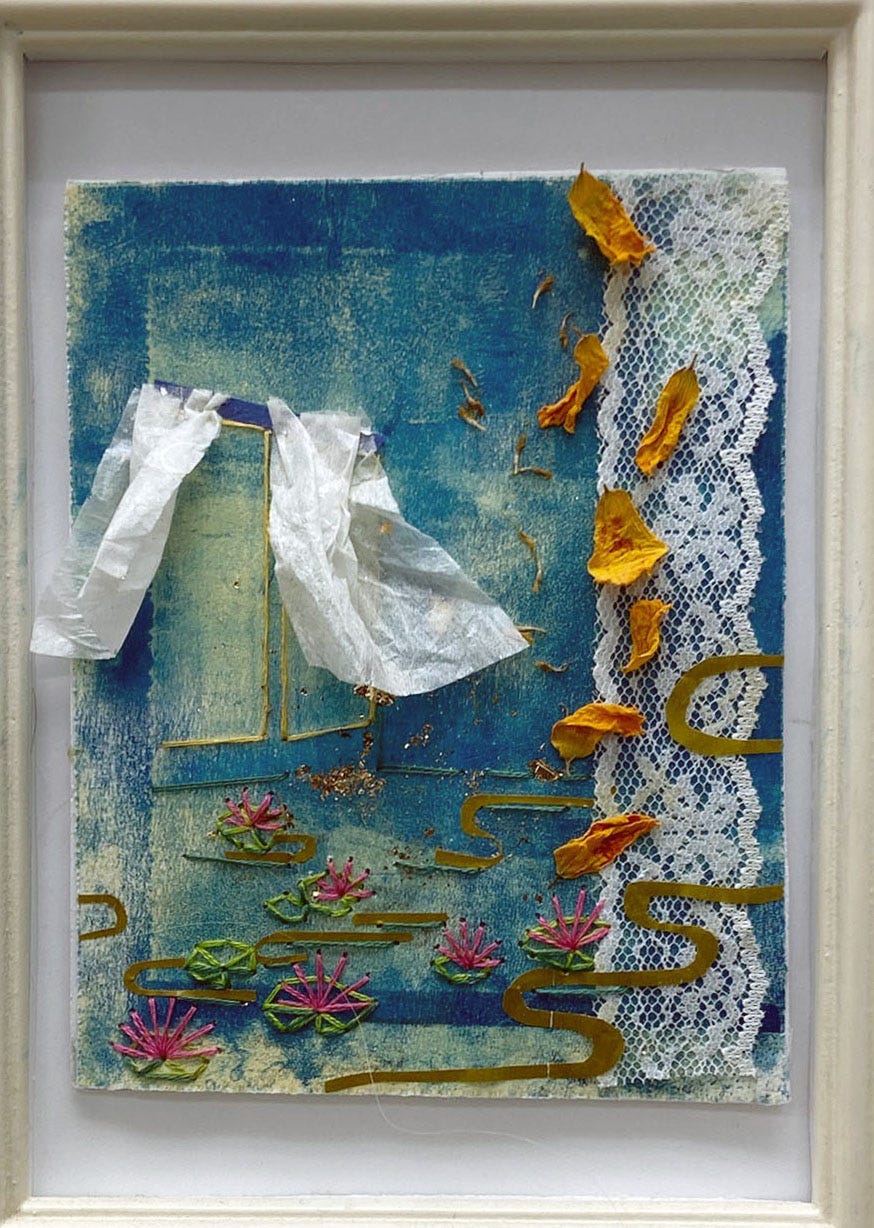
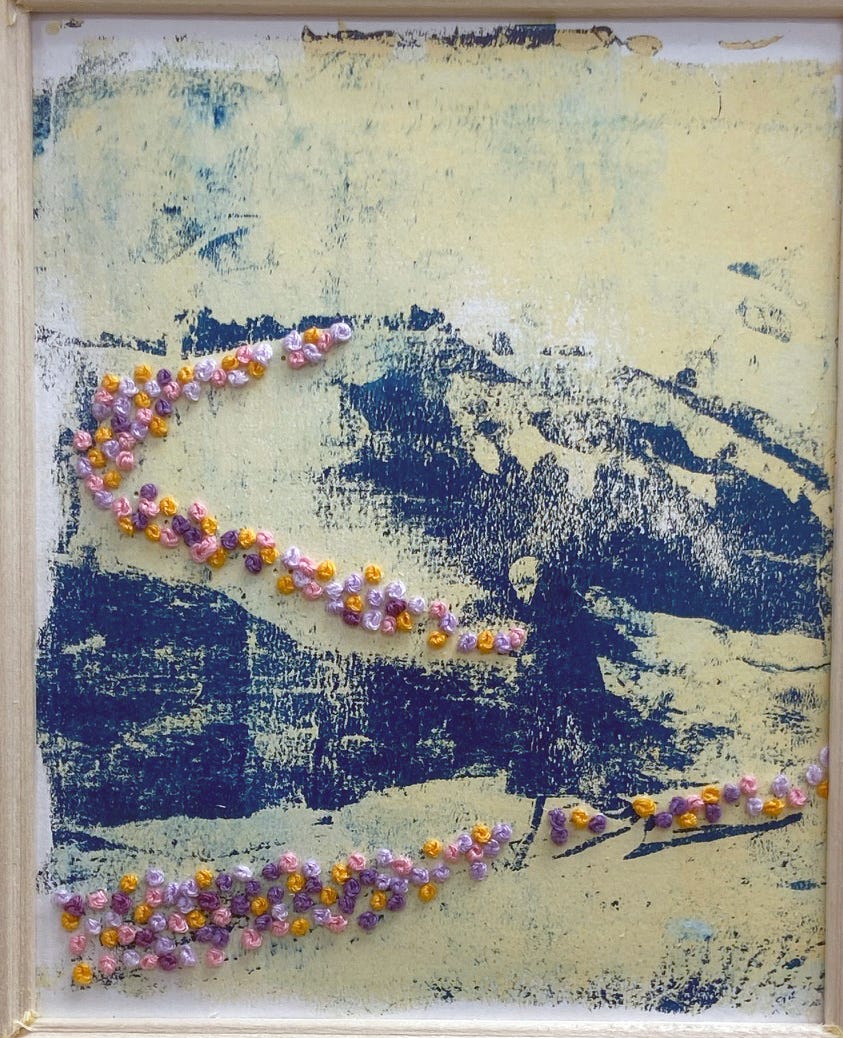
On to the words. Regarding collage and collaboration: One of the aspects of the two-headed word collage (and daCunha’s practice) are the possibilities that materials and actions present together. Magazine pages, cotton thread, reams of thought and introspection are arranged in close quarters. In general open edges of most collages signify the “verbs” of making (living). Collage, the noun, documents, physically, the artist’s labor. Artists collaborate with their materials. Sometimes the material is boss. Other times an artist’s experience can be a material as well. DaCunha’s I learned to live when I thought it was all over is one of those works (1st image below). It is embroidery, collage, dried plants, gelplate transfer on paper (4” x 6”). Small works like this, addressing universal images cause us to get up close to see the big picture. Literally, the artist’s use of an open window asserts the simultaneity of past, present and future space. We get a sense of the artist’s physical work as paper curtains hang out/in the window. Dried leaves and lace run on the right edge. The works are fragile but not weak. Here materials, next to each other, collaborate within each piece. By extension each work collaborates with each other. Its not overreaching then to say that the artist is collaborating with the larger world. DaCunha’s writing accompanies each collage in the show. This diaristic approach accompanies I learned to live when I thought it was all over “Being diasporic is about acceptance and letting go, while being stubborn as heck at the same time. We are here to stay, live, and thrive. Hope is the thing with feathers/ that perches in the soul”. Another work Path of Remembrance, a gelplate image transfer on paper with embroidery. It measures 5” x 7”. (2nd image below). The accompanying writing that could be from a diary reads: “…respect that which others see and touch, even if it is the opposite of what you yourself see and touch (Luigi Pirendello). By all means. Keep holding on. I sure find our relentless search of truth bewildering.”
IG: (at)xiaochineseart) website below IG: (at)bunkercenter.kc
To expand on this: A topic in painting is so-called positive and negative space. The space between each pair of words on the dictionary pages symbolize the so-called “negative space” we talk about in painting. The words become “positive space”. Its a subject for another time
https://www.xiaochineseart.com/